Book Appointment Now
Herniated Disc vs Slip Disc – Are They the Same Thing?
Walk into any pharmacy or clinic waiting room in India and mention back pain, and someone will inevitably say, “Ho sakta hai slip disc ho.” It’s become the go-to explanation for almost any spine-related pain. Meanwhile, doctors and MRI reports use the term “herniated disc.” Naturally, this leads to a common question: are these actually two different conditions, or just two names for the same thing?
Understanding the herniated disc vs slip disc difference matters more than it might seem — it affects how you interpret your diagnosis, what questions you ask your doctor, and how seriously you take your treatment plan. This article clears up the confusion once and for all, in plain, practical language.
The Short Answer
Here’s the part most articles bury too far down: “slip disc” and “herniated disc” refer to the same underlying condition. “Slip disc” is a popular, informal term widely used in India, while “herniated disc” (also called a “prolapsed disc” or “disc bulge” in related contexts) is the clinical term used in medical reports and diagnoses. There isn’t a real medical distinction — the confusion exists mostly because of language, not because of two separate conditions.
That said, understanding the actual mechanics behind the term “slip disc” helps clear up a common misconception: the disc doesn’t actually “slip” out of place the way the name suggests.
What Actually Happens in a Herniated (Slip) Disc
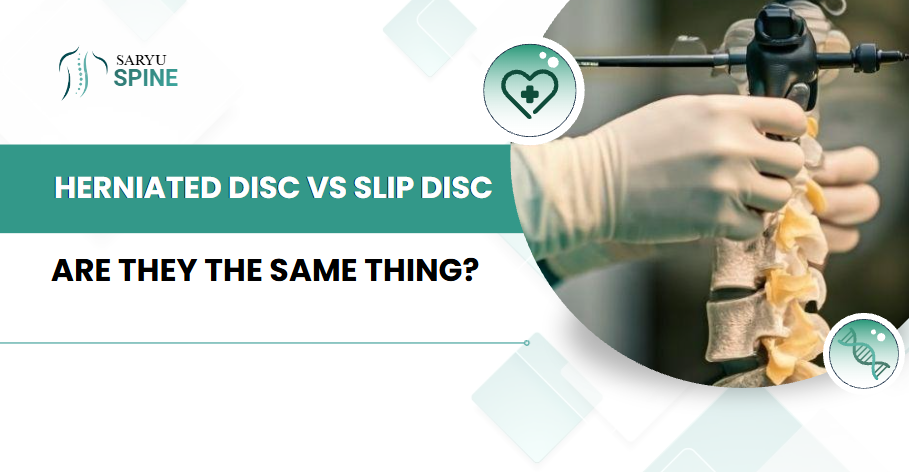
To understand the herniated disc vs slip disc difference — or rather, why there isn’t one — it helps to know what a spinal disc actually is. Each vertebra in your spine is cushioned by a disc made of two parts:
- Nucleus pulposus — a soft, gel-like center that absorbs shock
- Annulus fibrosus — a tougher, fibrous outer ring that holds the center in place
A herniated disc occurs when the outer ring weakens or tears, allowing the soft inner gel to push outward or through the tear. This bulging or leaking material can press against nearby spinal nerves, causing pain, numbness, or weakness. The disc doesn’t slip out of position like a book falling off a shelf — it’s a structural failure within the disc itself, which is why “herniation” is the more medically accurate term.
Where the Confusion Comes From
The term “slip disc” likely became popular because it’s an easier, more visual way for people to understand a complex spinal issue without medical training. It gives the impression of something physically shifting out of place, which is intuitive, even if not technically accurate. Over decades, it simply stuck as the common term across India, while doctors continued using “herniated disc” or “prolapsed disc” in clinical documentation.
This is worth knowing because if your MRI report says “disc herniation” or “disc prolapse” and you’ve been told you have a “slip disc,” there’s no need to panic thinking these are two separate diagnoses — they describe the same condition.
Disc Bulge vs Disc Herniation: A Related but Different Distinction
While “slip disc” and “herniated disc” are the same thing, there’s a genuinely different distinction worth understanding: disc bulge vs disc herniation.
- A disc bulge happens when the disc extends outward but the outer ring remains largely intact — often less severe and sometimes without significant symptoms.
- A disc herniation involves an actual tear in the outer ring, allowing inner material to push through, which is more likely to irritate or compress a nearby nerve.
This is a distinction many articles gloss over, but it’s clinically important because a bulge and a herniation don’t always require the same treatment approach or carry the same urgency.
Common Symptoms of a Herniated (Slip) Disc
Regardless of which term is used, the symptoms are the same:
- Localized back or neck pain, depending on the affected area
- Pain radiating into the arm or leg (commonly sciatica, when it’s a lumbar disc)
- Numbness or tingling in the affected limb
- Muscle weakness in the arm or leg
- Pain that worsens with sitting, bending, or coughing
What Causes a Herniated (Slip) Disc
- Age-related wear — discs naturally lose water content and flexibility over time, making them more prone to tearing
- Repetitive strain — frequent bending, twisting, or heavy lifting with poor technique
- Sudden injury — a fall, accident, or improper lifting of heavy weight
- Sedentary lifestyle — weak core and back muscles that fail to support the spine properly
- Genetics — some people are naturally more prone to disc degeneration
- Obesity — extra weight increases pressure on spinal discs, particularly in the lower back
How a Herniated (Slip) Disc Is Diagnosed
A doctor typically starts with a physical examination, checking reflexes, muscle strength, and the specific pattern of pain. If a disc problem is suspected, an MRI is the gold standard for confirming a herniation, showing exactly which disc is affected and whether it’s compressing a nearby nerve. X-rays, while useful for ruling out other issues like fractures, don’t show soft tissue like discs clearly.
Treatment Options: What Actually Works
This is where the biggest content gap exists online — most articles either oversell “quick home cures” or jump straight to surgery, without explaining the full range of options in between.
Conservative (Non-Surgical) Treatment — First Line for Most Cases
- Physiotherapy to strengthen supporting muscles and relieve nerve pressure
- Medication for pain and inflammation management
- Activity modification — avoiding movements that aggravate the disc
- Epidural steroid injections for more severe pain that isn’t responding to basic treatment
Most people with a herniated or slip disc improve significantly with these approaches within 6-12 weeks, without ever needing surgery.
When Surgery Becomes Necessary
Surgery is generally considered only when:
- Symptoms don’t improve after several weeks of conservative treatment
- There’s significant weakness or nerve damage
- Pain is severe enough to seriously impact daily life
- Imaging confirms significant nerve compression
Modern options like minimally invasive or endoscopic discectomy have made surgical recovery considerably faster than traditional open surgery, when surgery genuinely is the right path.
When to See a Spine Specialist
You should get a proper evaluation if you experience:
- Pain lasting more than 2 weeks without improvement
- Numbness, tingling, or weakness in an arm or leg
- Pain that disrupts sleep or daily activities
- Loss of bladder or bowel control (this requires emergency care)
Final Thoughts
There is no real herniated disc vs slip disc difference — they’re the same condition described in two different languages: one clinical, one colloquial. What actually matters isn’t which term your doctor uses, but understanding the condition itself, recognizing the symptoms early, and knowing that most cases respond very well to non-surgical treatment when caught in time.
Frequently Asked Questions (FAQs)
1. Is slip disc more serious than herniated disc?
No, they’re the same condition. “Slip disc” is simply the commonly used term in India for what doctors clinically call a “herniated disc.”
2. Can a slip disc heal without surgery?
Yes, most cases of slip disc (herniated disc) improve significantly with physiotherapy, medication, and activity modification within 6-12 weeks, without needing surgery.
3. What is the difference between a disc bulge and a slip disc?
A disc bulge involves the disc extending outward with the outer ring intact, while a slip disc (herniated disc) involves an actual tear allowing inner material to push through, often causing more nerve irritation.
4. How is a slip disc diagnosed?
An MRI scan is the most accurate way to diagnose a slip disc, as it clearly shows the affected disc and any nerve compression, unlike an X-ray.
5. When does a slip disc require surgery?
Surgery is usually only needed if symptoms don’t improve after several weeks of conservative treatment, or if there’s significant weakness or nerve compression confirmed on imaging.