Book Appointment Now
Early Signs of Degenerative Spine Disease You Shouldn’t Ignore
Most people assume spine problems announce themselves loudly a sudden sharp pain, an inability to move, something dramatic. In reality, degenerative spine disease rarely works that way. It creeps in quietly, showing up as mild stiffness after a long drive, a slightly reduced range of motion, or a dull ache that comes and goes. By the time the pain becomes hard to ignore, the degeneration has often been building for years.
Recognizing the early signs of degenerative spine disease is exactly what makes the difference between managing the condition with simple lifestyle changes and ending up with limited treatment options down the line. This article walks through what actually happens to the spine as it degenerates, the early warning signs most people miss, and what to do about it before the condition progresses.
What Is Degenerative Spine Disease?
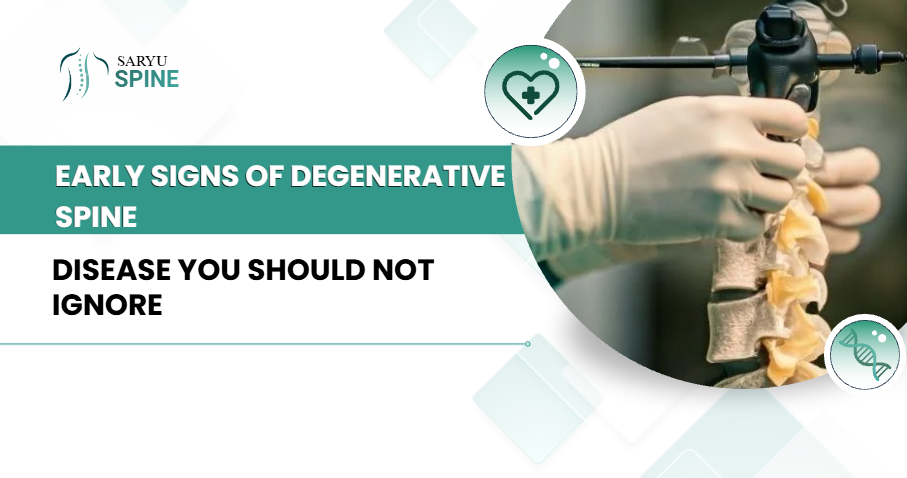
Degenerative spine disease refers to the gradual wear and tear of the structures that make up the spine the intervertebral discs, joints, ligaments, and vertebrae. As we age, the discs that cushion the vertebrae naturally lose water content and elasticity, becoming thinner and less able to absorb shock. The joints connecting the vertebrae (facet joints) can also develop arthritis-like changes over time.
This isn’t automatically a disease requiring treatment some degree of spinal wear is a normal part of aging, and many people have degenerative changes visible on scans with no symptoms at all. The concern arises when this wear starts compressing nerves, restricting movement, or causing structural instability, which is when it starts to affect day-to-day life.
Why Degenerative Spine Disease Is Starting Earlier Than Before
While this condition has traditionally been associated with people over 50, we’re now seeing early degenerative changes in patients in their 30s and even late 20s. A few reasons stand out:
- Sedentary lifestyles that weaken the muscles supporting the spine, shifting more load onto the discs and joints
- Prolonged sitting in offices and during commutes, which increases pressure on the lumbar discs
- Poor posture habits developed over years of screen use
- Obesity and inactivity, which accelerate disc wear
- Previous injuries that were never properly rehabilitated
- Smoking, which reduces blood flow to spinal discs and speeds up degeneration
Early Signs of Degenerative Spine Disease
This is the part that matters most — catching the condition while it’s still manageable. Here are the early signs of degenerative spine disease that are commonly dismissed as “normal aging” or “just tiredness.”
1. Morning Stiffness That Eases With Movement
One of the earliest and most overlooked signs is stiffness first thing in the morning that gradually loosens up once you start moving around. This pattern — worse at rest, better with light activity — is a classic early indicator of spinal joint degeneration.
2. Pain That Worsens With Prolonged Sitting or Standing
If sitting through a long meeting or standing in a queue leaves your lower back aching, but the discomfort eases once you change position, it often points to early disc or joint changes rather than a muscular strain.
3. Reduced Flexibility
Struggling to bend down to tie your shoes, or noticing you can’t twist your torso as far as you used to, can indicate that the spinal joints and discs are losing their normal range of motion.
4. Occasional Numbness or Tingling
As discs lose height, they can begin to press slightly on nearby nerves, causing intermittent tingling or numbness in the arms or legs — often mild enough to be ignored at first.
5. A Popping or Grinding Sensation
Some people notice a grinding, cracking, or popping feeling when moving the neck or back. While occasional cracking is usually harmless, a persistent grinding sensation accompanied by discomfort can signal joint surface wear.
6. Pain That Radiates
Early nerve involvement can cause pain to travel from the spine into the shoulder, hip, or leg — a sign that degeneration may be starting to affect the space around the nerve roots.
7. Fatigue From Poor Posture Support
As the spine’s natural shock-absorbing capacity reduces, muscles have to work harder to compensate, leading to unusual fatigue in the back and neck by the end of the day, even without intense physical activity.
8. Height Changes or Postural Shifts
In more advanced early stages, disc thinning across multiple levels can contribute to a very gradual loss of height or a slightly stooped posture — subtle enough that it’s often noticed by family before the person themselves.
What Happens If Early Signs Are Ignored
This is where most of the content available online falls short — it lists symptoms but doesn’t explain what’s actually at stake if they’re brushed aside. Left unaddressed, early degenerative changes can progress to:
- Spinal stenosis — narrowing of the spinal canal that compresses nerves
- Herniated discs — where worn discs bulge or rupture under load
- Nerve compression — leading to persistent pain, numbness, or weakness
- Reduced mobility — making everyday tasks progressively harder
- Spinal instability — in advanced cases, requiring more involved treatment
The progression is usually slow, which is precisely why it’s dangerous — there’s rarely one dramatic moment that forces action, just a gradual normalization of discomfort that eventually limits what a person can do.
How to Slow Down Degenerative Spine Disease
The reassuring part is that recognizing the early signs of degenerative spine disease gives you a real window to slow the process down significantly.
1. Stay Consistently Active
Regular low-impact activity walking, swimming, or cycling keeps the spine’s supporting structures engaged without overloading them.
2. Strengthen Core and Back Muscles
Strong core muscles take pressure off the spinal discs and joints, directly reducing the mechanical stress that accelerates degeneration.
3. Maintain a Healthy Weight
Every extra kilogram adds disproportionate load to the lower spine over the course of a day, so weight management has an outsized impact on spine health.
4. Fix Posture Early
Correcting sitting and standing posture, especially during long work hours, reduces uneven pressure on spinal discs.
5. Avoid Smoking
Since smoking reduces blood supply to spinal discs, quitting can meaningfully slow the rate of degeneration.
6. Get Regular Movement Breaks
If your day involves long sitting stretches, breaking it up every 30-45 minutes helps prevent the stiffness that compounds over years into structural change.
When to See a Spine Specialist
Lifestyle changes work well when degeneration is caught early. However, a proper evaluation is needed if you notice:
- Pain lasting more than 3-4 weeks
- Numbness, tingling, or weakness that doesn’t go away
- Pain radiating into an arm or leg
- Noticeable reduction in mobility
- Symptoms that are gradually getting worse rather than staying stable
An evaluation, often involving imaging like an X-ray or MRI, can determine exactly how much degeneration has occurred and whether it’s still in a stage that responds well to physiotherapy and lifestyle correction, or whether more targeted treatment is needed. Most cases, especially when caught early, do not require surgery.
Final Thoughts
Degenerative spine disease doesn’t happen overnight, and that’s exactly what makes early detection so valuable. The early signs of degenerative spine disease — morning stiffness, reduced flexibility, occasional numbness, and fatigue-related back pain — are easy to dismiss individually, but together they tell an important story about how your spine is aging. Catching these signs early and making consistent lifestyle changes can significantly slow the condition, keeping surgery off the table for most people.
Frequently Asked Questions (FAQs)
1. At what age do degenerative spine disease symptoms usually start?
While traditionally linked to people over 50, early degenerative changes are now being seen in people in their late 20s and 30s due to sedentary lifestyles and poor posture.
2. Is degenerative spine disease the same as arthritis of the spine?
They’re closely related. Degenerative spine disease often includes arthritis-like changes in the spinal joints, along with disc wear, leading to similar stiffness and pain patterns.
3. Can degenerative spine disease be reversed?
The degeneration itself generally can’t be fully reversed, but its progression can be significantly slowed with exercise, posture correction, and healthy lifestyle habits, especially when caught early.
4. What is the best exercise for early degenerative spine disease?
Low-impact activities like walking, swimming, and core-strengthening exercises are generally the most effective for supporting a spine with early degenerative changes.
5. When should I get an MRI for suspected spine degeneration?
If symptoms like pain, numbness, or reduced mobility persist for more than 3-4 weeks or are getting worse, a doctor may recommend an MRI to assess the extent of degeneration.