Book Appointment Now
Endoscopic Spine Surgery in India: How It Works, Who Is Suitable, Benefits, Risks and Recovery
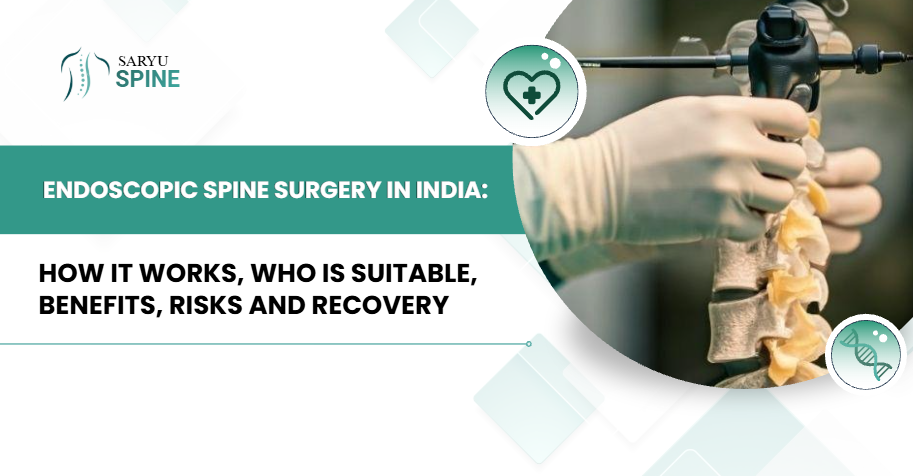
Endoscopic spine surgery in India is a type of minimally invasive, “keyhole” spine surgery in which the surgeon operates through a very small opening using a thin tube with a camera (an endoscope). It is most commonly used to treat a slipped (herniated) disc and some forms of nerve canal narrowing (stenosis). In suitable patients, it can mean a very small incision, less damage to back muscles, a shorter hospital stay and a quicker return to daily life.
But endoscopic surgery is not the right choice for every spine problem, and a smaller cut does not automatically mean a better result. This guide by Dr. Sameer Nagpal explains how the procedure works, which conditions it treats, who is a good candidate, how recovery looks, what the risks are and how it compares with other operations.
Key Takeaways
- Endoscopic spine surgery uses a camera and instruments passed through a tiny opening, often less than about 1 cm in full endoscopic techniques.
- It is mainly used for selected disc herniations and some types of stenosis.
- Possible benefits include less muscle damage, smaller scars and faster early recovery.
- It is not suitable for every patient or condition, such as significant spinal instability or severe deformity.
- Surgeon training and experience matter a great deal, because the technique has a learning curve.
- Most spine problems do not need surgery at all and improve with non-surgical care.
What Is Endoscopic Spine Surgery?
An endoscope is a slim instrument with a light and a high-definition camera. In endoscopic spine surgery, the surgeon makes a small incision, guides a narrow working channel to the problem area under X-ray guidance, and operates while watching the magnified image on a screen. Specially designed small instruments are passed through the same channel to remove the part of the disc or bone that presses on the nerve.
Because the instruments pass between muscle fibres rather than cutting or stripping them, there is usually less trauma to the surrounding tissue than in traditional open surgery.
People often call it “keyhole spine surgery” or “endoscopic discectomy”. You may also hear the terms “full endoscopic” and “biportal endoscopic” (UBE), which we explain below.
Types of Endoscopic Spine Surgery
Different techniques exist, and the best one depends on the level of the spine, the type of problem and the surgeon’s training.
1. Full (uniportal) endoscopic surgery
A single, very small incision is used, and instruments pass through one channel along with the camera. It can be done by two main routes:
- Transforaminal approach: reaches the disc from the side, through the opening where the nerve exits. It is commonly used for disc herniations and foraminal narrowing.
- Interlaminar approach: reaches the canal from the back, between two vertebrae. It is useful for certain herniations, particularly at the lowest lumbar level, and for some stenosis cases.
2. Biportal endoscopic surgery (UBE or BESS)
Two small incisions are used, one for the camera and one for the instruments. It allows a somewhat wider working space and is used for decompression in stenosis and some disc problems.
3. Cervical (neck) endoscopic procedures
Selected neck problems, such as a pinched nerve from a disc or bone spur, can sometimes be treated through a small opening at the back of the neck.
Fusion using endoscopic assistance is also being developed, but it is a specialised and evolving area and is not suitable for everyone.
Conditions Treated with Endoscopic Spine Surgery
- Lumbar slip disc (herniated disc) causing sciatica
- Foraminal stenosis, where the exit tunnel of the nerve is narrowed
- Lateral recess stenosis, a side narrowing of the canal
- Selected cases of central lumbar canal stenosis
- Selected cervical disc herniations or nerve root compression
- Recurrent disc herniation in some patients
If you want to understand your condition first, read our guides on slip disc treatment without surgery, sciatica treatment in India and lumbar canal stenosis treatment.
Who Is a Good Candidate?
You may be a candidate if:
- Your symptoms match your MRI, for example a disc pressing on the nerve that explains your leg pain
- The problem is limited to one or two levels
- Non-surgical treatment such as medicines, physiotherapy and sometimes injections has been tried for an appropriate time without enough relief, or there is progressive weakness
- Your spine is stable, and you do not need to be fused
- Your surgeon has specific training and experience with the technique
Who May Not Be a Good Candidate?
Another operation may be safer or more effective if you have:
- Significant spinal instability or a slipped vertebra needing fusion (see our guide on spondylolisthesis treatment)
- Severe deformity, such as marked scoliosis
- Severe multilevel stenosis needing wide decompression
- A very large, calcified or highly migrated disc that is hard to reach endoscopically
- Spinal infection or tumour
- Previous multiple surgeries with heavy scarring
- Medical conditions that make surgery unsafe
Your surgeon should explain why a particular technique is chosen for you, and what the alternatives are.
How Is Endoscopic Spine Surgery Done?
The exact steps differ by technique, but in general:
- Anaesthesia: depending on the technique and patient, it may be done under local anaesthesia with sedation, spinal or epidural anaesthesia, or general anaesthesia. Your anaesthetist and surgeon will advise what suits you.
- Positioning and marking: you lie on your side or stomach, and the level is marked with X-ray guidance.
- Small incision: a small cut is made, often less than about 1 cm in full endoscopic techniques, and a thin working channel is placed.
- Visualisation: the endoscope shows a magnified view of the nerve and disc on a screen.
- Decompression: the herniated disc fragment or the bone and tissue pressing on the nerve is removed with small instruments.
- Closure: the incision is closed with a stitch or skin glue and a small dressing is applied.
Procedure time varies with the problem and technique. Many patients walk the same day or the next.
Benefits of Endoscopic Spine Surgery
When the patient and condition are right, the possible benefits include:
- Very small scars
- Less muscle damage, since muscles are separated rather than cut
- Less blood loss
- Shorter hospital stay, with many patients going home early
- Earlier walking and return to daily activities
- Possible suitability for some patients where general anaesthesia is a concern, depending on the technique and the anaesthetist’s assessment
Please note that long-term results for many disc problems are often similar between well-performed endoscopic discectomy and microscopic discectomy. The differences are mostly in the early recovery period, and the right choice depends on your case.
Endoscopic vs Microscopic vs Open Spine Surgery
| Feature | Endoscopic | Microscopic (tubular) | Open |
|---|---|---|---|
| Incision | Smallest, often under about 1 cm (full endoscopic) | Small, about 1 to 3 cm | Longer |
| Muscle disturbance | Least | Less | More |
| Hospital stay | Often shortest | Often short | Often longer |
| Best for | Selected disc and foraminal problems, some stenosis | Discectomy, decompression | Complex, multilevel, unstable or deformity cases |
| Learning curve | High | Moderate | Standard |
| Final goal | Relieve nerve pressure | Same | Same |
For a broader comparison, see our guide on minimally invasive spine surgery in India.
Risks and Limitations
Every operation has risks, and you deserve a clear explanation. Endoscopic spine surgery can carry:
- Recurrence of disc herniation, which can occur after any disc surgery
- Incomplete decompression, which may need a second procedure
- Nerve irritation or injury, causing numbness, weakness or persistent pain
- Dural tear (a small leak of spinal fluid)
- Infection
- Bleeding
- Conversion to a larger procedure if the problem cannot be fully addressed endoscopically
- Anaesthesia-related risks
- Persistent pain, particularly if nerve damage was present before surgery
Other limitations:
- It requires special equipment and training.
- It is not available or equally experienced everywhere.
- Its use for complex stenosis or fusion is evolving and should be discussed carefully.
Recovery After Endoscopic Spine Surgery
Recovery varies with the technique and your health. A general picture:
| Stage | What to expect |
|---|---|
| Day of surgery | Mobilising with support; leg pain often improves quickly, though some numbness can persist |
| Hospital stay | Often a day or so; some patients go home the same day |
| First 2 weeks | Short, frequent walks; wound care; avoid bending, lifting and twisting |
| 2 to 6 weeks | Gradual return to routine; many return to desk work within this period, as advised |
| 6 to 12 weeks | Physiotherapy and core strengthening; return to normal activity |
| After 3 months | Return to heavier work or sports, when your surgeon approves |
These are general guides. Your surgeon will give timelines that suit your operation, work and health.
Tips for a smooth recovery
- Walk every day and increase distance gradually
- Follow bending, lifting and twisting restrictions
- Do not smoke, since it affects disc and wound healing
- Complete physiotherapy to strengthen your core
- Maintain a healthy weight
- Attend all follow-up visits
- Take medicines only as prescribed
Warning signs after surgery
Contact your surgeon promptly, or go to the emergency department, if you have:
- Fever or chills
- Redness, swelling or discharge from the wound
- New or worsening leg weakness or numbness
- Bladder or bowel problems or numbness in the groin
- Severe pain not controlled by medicines
- Calf swelling, chest pain or breathlessness
You can read more about urgent symptoms in our guide on back pain red flag symptoms.
Do You Actually Need Surgery?
Many spine problems improve without an operation. Surgery, including endoscopic surgery, is usually considered when:
- Severe pain continues despite about 6 to 12 weeks of proper non-surgical treatment
- There is progressive weakness or foot drop
- Pain badly affects work, sleep and daily life
- The MRI clearly shows nerve compression that matches your symptoms
- There are emergency signs such as bladder or bowel changes
If you are unsure, take a second opinion from an experienced spine surgeon in India before deciding.
Myths and Facts About Endoscopic Spine Surgery
Myth: Endoscopic surgery means no real surgery.
Fact: It is real surgery with the same goal as other operations and with comparable types of risks.
Myth: It is the best option for every back problem.
Fact: It suits selected conditions. Instability, deformity and some complex stenosis need other approaches.
Myth: It is done with a laser.
Fact: “Laser spine surgery” is often a marketing term. Endoscopic surgery uses a camera and small instruments. Ask your surgeon exactly which instruments and technique are planned.
Myth: Everyone goes home the same day.
Fact: Many do, but it depends on the operation, your health and your surgeon’s protocol.
Myth: Endoscopic surgery can never fail.
Fact: Disc herniation can recur, and symptoms can persist, as with any disc surgery.
Myth: A smaller incision means a better result.
Fact: Results depend on correct diagnosis, patient selection and surgeon skill.
Questions to Ask Your Surgeon
- What is my exact diagnosis, and is surgery truly necessary?
- Am I a good candidate for endoscopic surgery, and why?
- Which endoscopic technique do you recommend, and which approach?
- How many of these procedures do you perform?
- What are the benefits and risks specific to my case?
- What would the alternative operation be, and how do they compare for me?
- What if the endoscopic approach cannot be completed?
- How long will I stay in hospital, and when can I return to work?
- Which warning signs should make me contact you urgently?
Bring your MRI films, previous reports and medicine list to the consultation.
Is Endoscopic Spine Surgery Covered by Insurance in India?
Coverage depends on your insurer and policy terms, waiting periods and whether the procedure is accepted. Request pre-authorisation in advance and ask your hospital’s insurance desk about any non-payable items. Our guide on spine surgery insurance coverage in India explains the process in detail.
Frequently Asked Questions
1. What is endoscopic spine surgery?
It is keyhole spine surgery done through a very small opening using a camera and thin instruments to relieve pressure on nerves, most often from a slipped disc.
2. Is endoscopic spine surgery safe?
When performed by an experienced surgeon on a suitable patient, it is generally safe, but like all surgery it has risks such as infection, nerve injury and recurrence.
3. Is endoscopic spine surgery better than open surgery?
It can offer less muscle damage and faster early recovery in suitable patients, but long-term results are often similar. It is better only when it suits your condition.
4. What conditions can be treated with endoscopic spine surgery?
Selected lumbar disc herniations, foraminal and lateral recess stenosis, some central stenosis cases and selected cervical nerve root problems.
5. Is endoscopic spine surgery done under local anaesthesia?
Sometimes, depending on the technique, the patient and the anaesthetist’s advice. Others need spinal, epidural or general anaesthesia.
6. How long is the hospital stay after endoscopic spine surgery?
Often short, from same-day discharge to about a day or two, depending on the case.
7. How long does recovery take?
Many people return to light activity within days to a few weeks and desk work within a few weeks, while full recovery takes longer. Your surgeon will guide you.
8. Can a disc slip again after endoscopic surgery?
yes, recurrence is possible after any disc surgery. Good posture, core strength and weight control help reduce the risk.
9. Is endoscopic spine surgery painful?
There is some pain, but incision pain is usually mild. It is managed with medicines.
10. Can endoscopic surgery be used for spinal fusion?
Endoscopic-assisted fusion is a specialised, evolving technique for selected patients. Many fusions are done with other minimally invasive or open methods. Learn more in our guide on spinal fusion surgery recovery time.
11. How do I know if I am a candidate?
Your surgeon reviews your symptoms, examination and MRI, and considers your condition, the level, stability of the spine and your health.
12. How do I choose a surgeon for endoscopic spine surgery?
Look for a surgeon with specific spine training, experience in endoscopic techniques, honest discussion of alternatives and a willingness to say when surgery is not needed.
Conclusion
Endoscopic spine surgery has made some spine operations far less disruptive. For suitable patients with a slipped disc or a pinched nerve, it can mean a tiny incision and a quick return to normal life. But the best operation is the one that fits your diagnosis, not the one that sounds the most advanced. A careful evaluation, an honest conversation about your options and an experienced surgeon matter more than any technique’s name.
If you have leg pain, a slipped disc or a pinched nerve and want to know whether endoscopic surgery is right for you, book a consultation with Dr. Sameer Nagpal for a personalised evaluation and treatment plan.
Related reading